

Certificates and ecolabels
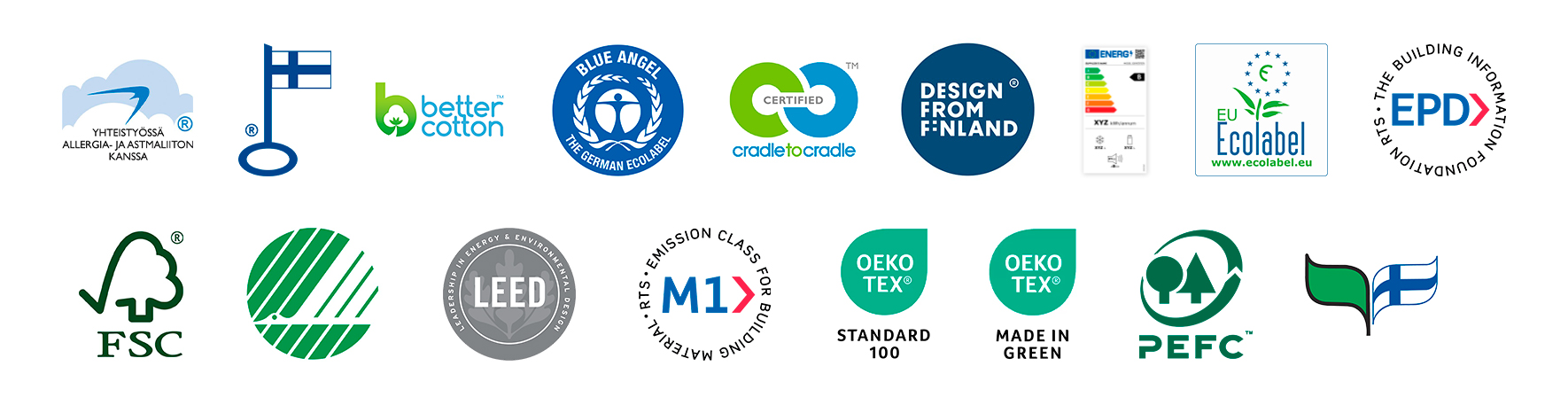
Allergy Label
The Allergy Label shows that the product meets certain allergy criteria. Products that have received the label do not contain fragrances or generally sensitising or irritating substances or materials. In addition to substances, the concentrations used are also investigated, as some of the chemicals are well tolerated when the concentration used in the composition is low.
The Allergy Label is awarded by Allergia-, Iho- ja Astmaliitto ry, which carries out the evaluation in cooperation with external experts and researchers.
https://www.allergia.fi/allergiatunnus/
Key Flag
The Key Flag label helps the customer choose a Finnish option. The label indicates that the product is manufactured, or the service is produced, in Finland and employs people in Finland.
The Key Flag label is awarded by the Association for Finnish Work.
https://suomalainentyo.fi/yrityksille/avainlippu/
Better Cotton
Better Cotton is the world’s leading cotton sustainability initiative. Better Cotton’s goal is to help cotton producers make a living and prosper. Better Cotton’s goal is also to protect and restore the environment. As a member of Better Cotton, Kesko is committed to developing cotton farming practices globally.
The cotton supply chain has several phases. Better Cotton materials are not traced to individual products; instead, cotton is sourced using a Mass Balance system. Even if Better Cotton blends into regular cotton along the way, its total amount in the supply chain remains the same.
Blue Angel
Blue Angel is a German ecolabel that sets strict standards for environmentally friendly products and services. The Blue Angel label indicates that the product puts less strain on the environment and meets high standards to protect human health – while having the same usefulness and good quality as other products.
The Blue Angel label is managed by the German Ministry of the Environment in cooperation with several other organisations.
https://www.blauer-engel.de/en
Cradle to Cradle (C2C)
A Cradle to Cradle certified material or product has undergone a safety, circular economy and sustainability assessment in five categories: safety of materials for humans and the environment, the circular economy and recycling opportunities, renewable energy use and climate impacts, sustainable use of water and soil, and respect for human rights and fair trade practices.
The Cradle to Cradle label is awarded by the Cradle to Cradle Products Innovation Institute.
Design from Finland
Design from Finland products and services are designed in Finland in a professional, responsible and user-oriented manner.
The Design from Finland label is awarded by the Association for Finnish Work.
https://suomalainentyo.fi/en/services/design-from-finland/
Energy Label
The Energy Label helps consumers choose devices that consume the least amount of electricity. The Energy Label common for EU countries provides reliable comparable information about the energy consumption of household appliances.
The data is based on the results measured by manufacturers in accordance with the standard. In Finland, the Ministry of the Environment is responsible for the preparation of energy label regulations for building products and the Energy Authority answers for all other product groups. The accuracy of energy labels is monitored by the Finnish Safety and Chemicals Agency (TUKES).
https://energiamerkinta.fi/energiamerkinta/
EU Ecolabel
The EU Ecolabel impartially indicates the reduced environmental burden of the product and service, without neglecting safety and quality. Recurring themes in the label’s criteria include energy efficiency, chemical safety and sustainably produced raw materials. The criteria are developed in cooperation between all EU countries, and the awarded label is valid throughout the EU.
In Finland, the EU Ecolabel is awarded by Ympäristömerkintä Suomi Oy.
https://eu-ymparistomerkki.fi/
Environmental Product Declaration
An Environmental Product Declaration (EPD) is an environmental statement that describes the environmental impact of a product over its entire life cycle. The environmental impact has been calculated using life cycle analysis (LCA) from raw material procurement to final disposal.
The EPD standard is an international standard. A third-party certifier approved in accordance with the standard ensures that the information presented in the EPD has been verified and identified as a reliable source of environmental information.
FSC
FSC-labelled products include materials obtained from or recycled from FSC-certified forests. Forests are managed according to strict social and environmental standards. The FSC 100% label indicates that the product is made entirely of FSC material. FSC Mix products contain at least 70% of materials from FSC-certified forests and the rest is recycled materials or FSC-controlled wood. The FSC Recycled label indicates that the material is completely recycled.
FSC Finland promotes FSC certification and grants the right to use the FSC trademark in Finland. Approved certification organisations issue both forest management certificates and chain of custody certificates.
Kesko’s FSC licence code is FSC-N001690.
Nordic Swan Ecolabel
The Nordic Swan Ecolabel is awarded to products and services that meet ambitious environmental requirements. The Nordic Swan Ecolabel criteria holistically examine the environmental impact of products and services from a wide range of perspectives. In addition to the environment, the focus is on requirements related to chemicals and health. The criteria take into account the entire life cycle of the product, from raw materials, production and use to recycling and disposal.
The Nordic Swan Ecolabel is awarded by Ympäristömerkintä Suomi Oy.
https://joutsenmerkki.fi/tietoa-joutsenmerkista/
LEED
The Leadership in Energy and Environmental Design (LEED) rating is the world’s most widely used global environmental rating system for buildings. LEED certified buildings save money, improve efficiency, reduce carbon emissions, and create healthier places for people.
The LEED label for buildings is developed by the U.S. Green Building Council (USGBC), and the evaluation process is carried out by The Green Business Certification Inc. (GBCI). The LEED label in the context of a product suggests that the manufacturer itself has clarified the requirements for its corresponding LEED certified construction.
https://figbc.fi/tyokalu/leed/
M1
The purpose of the Emission Classification of Building Materials is to promote the use of low-emission building materials and fixtures. It sets out requirements for materials used in conventional working and living spaces concerning good indoor air quality. The M1 rating label on a product indicates that the product is odourless and has low emissions in accordance with M1 requirements.
The M1 rating is awarded by the Building Information Foundation RTS.
https://www.rakennustieto.fi/palvelut/ymparistopalvelut/m1-luokitus
OEKO-TEX 100
Every component of an OEKO-TEX STANDARD 100 product, i.e. every thread, button and other accessories, has been tested for harmful substances to show that the product is harmless to human health.
The OEKO-TEX label is awarded by the International Association for Research and Testing in the Field of Textile and Leather Ecology, formed by several research institutions.
https://www.oeko-tex.com/en/our-standards/oeko-tex-standard-100
OEKO-TEX Made in Green
OEKO-TEX MADE IN GREEN is a traceable brand for all kinds of textiles and leather products manufactured using environmentally friendly methods and in socially responsible working conditions. The MADE IN GREEN label also indicates that a textile or leather product is made of materials that have been tested for harmful substances.
The OEKO-TEX label is awarded by the International Association for Research and Testing in the Field of Textile and Leather Ecology, formed by several research institutions.
https://www.oeko-tex.com/en/our-standards/oeko-tex-made-in-green
PEFC
The PEFC label indicates that wood from sustainably managed forests has been used for the product. The PEFC label can be used to ensure the sustainability and origin of the product. The PEFC label can be used on a product when at least 70% of the forest and wood material it contains is PEFC certified, and the rest is recycled material or FSC controlled wood. The PEFC Recycled label indicates that the material is completely recycled.
PEFC Finland – the Finnish Forest Certification Council promotes PEFC certification and grants the right to use the PEFC trademark in Finland. Approved certification organisations issue both forest management certificates and chain of custody certificates.
PEFC trademarks on products indicate PEFC certification. Kesko’s licence number is PEFC/02-44-36.